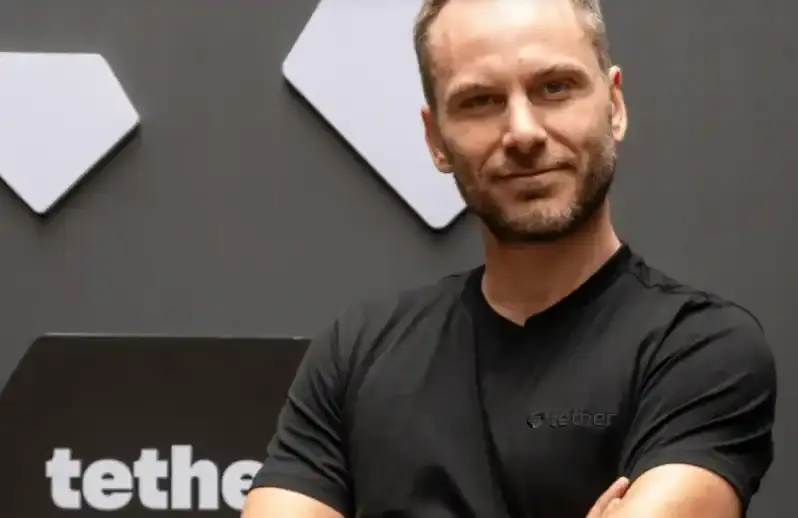
During the Global Bitcoin Conference in late May, Paolo Ardoino, CEO of Tether, the issuer of the world’s largest stablecoin USDT, was interviewed by CNBC.
In his speech at the Bitcoin Conference, Paolo Ardoino stated that USDT has approximately 420 million users in emerging markets and developing countries, accounting for 62% of decentralized trading volume. “What’s more significant is that approximately 35% of USDT users use it as a savings account—because they live in countries like Turkey, Argentina, and Vietnam where their local currencies have severely depreciated, leaving them with no choice but to deposit in US dollars, and USDT is their most practical option.”
According to Coingecko data on June 18, USDT’s total market capitalization was approximately $155 billion, with a 24-hour trading volume of about $27.7 billion, making it the world’s largest stablecoin issuer; The recently listed “first stablecoin stock” Circle (CRCL.US) has a total market capitalization of approximately $61.5 billion for its USDC, with a 24-hour trading volume of approximately $9.2 billion.
However, market analysts believe that under the framework of the “Genius Act” (i.e., the “Guidance and Establishment of the U.S. Stablecoin National Innovation Act,” which was passed by the U.S. Senate on June 17 and is now awaiting review by the U.S. House of Representatives), Tether’s compliance standards are lower than Circle’s, which is one of the reasons why Circle was listed before Tether. Paolo Ardoino also addressed issues related to “offshore structures” and audits in an interview, stating that they have had good communication with the Big Four accounting firms. However, he also noted that “this will be a long process.”
Notably, Paolo Ardoino specifically shared the logic behind Tether’s investments in agriculture, dairy, video platforms, and brain-computer interface technology companies.
According to Tether’s official website, Tether announced on April 30 this year the acquisition of Latin American agricultural company Adecoagro, whose core businesses include sugar, ethanol, dairy products, and crop production in Argentina, Brazil, and Uruguay. The company owns 210,400 hectares of farmland and multiple industrial facilities in these countries.
In the interview, Paolo Ardoino stated, “We are also exploring how to demonstrate to agricultural companies and commodity producers (such as wheat, rice, and milk) how to use stablecoins for international trade. For example, Adecoagro exports its products to Asia and the United States, and to make these sales more efficient, they are beginning to consider using stablecoins for transactions.”
Tether recently announced an investment, acquiring a 31.9% stake in Canadian gold royalty company Elemental Altus Royalties on June 12. Tether stated that this investment is part of its commitment to “integrate long-term stable assets like gold and Bitcoin into its ecosystem,” serving both as a hedging tool and as part of its pledge to build resilient digital economic infrastructure.
Host: Tether is one of the most profitable companies in the world per employee. Before we dive into your stablecoin strategy and some of the work you’re doing, I’m interested in some of your recent investments, including your investment in a Brazilian dairy company. So please talk about your investments in artificial intelligence and neuroscience, as well as why you are bullish on dairy products and milk in the long term.
Paolo: First, thank you for the invitation. From the outside, people might think we’re doing random things, but that’s not the case.
Host: When you have a lot of capital, you have to invest wisely, which is why I’m curious about what you’re doing.
Paolo: Over the past two and a half years, we’ve generated $20 million in profits. You have to think carefully and develop a very precise investment plan. We receive hundreds of investment proposals every day, so we have to be selective. A portion of our investments—by the way, these are investments outside of our stablecoin reserves, just to clarify—are long-term safe investments, such as land and agriculture. Tether is renowned for creating and owning the world’s largest stablecoin, USDT, which is a tool that brings stability to people, communities, and nations. We bring stability to countries with extremely fragile national currencies, such as the Argentine peso or Turkish lira, so stability is at the core of what we do. And for long-term human stability, nothing is more stable or essential than land and agriculture.
We invest in Adecoagro—a publicly traded company and the largest single landowner in Argentina, Uruguay, and Brazil—because we want our portfolio to access “true Bitcoin”—land, as land is scarce and cannot be created. Of course, one could argue for creating more land on Mars, but in reality, humanity will always need land, good agriculture, to survive and thrive. This is why we allocate a portion of our portfolio to land-related businesses. Additionally, we are exploring how to demonstrate to agricultural companies and commodity producers (such as wheat, rice, milk, etc.) how to use stablecoins for international trade. For example, Adecoagro exports its products to Asia and the United States, and to make these sales more efficient, they are beginning to consider using stablecoins for transactions. This is a highly attractive approach because we believe commodity trading companies will be the largest drivers of stablecoin adoption over the next five years.
Of course, we also have investments in other new technologies, such as artificial intelligence or biotechnology. I really like these fields because I’m essentially a geek, so we invested in NorthernData. We are a major shareholder in NorthernData, which may be the world’s largest independent AI infrastructure provider. By “independent,” we mean not Google, not Microsoft, not Amazon. They have 24,000 GPUs, and we plan to utilize these resources at Tether to develop our own AI models in the future. We are building our own AI platform at Tether. We have also invested in biotechnology and neurotechnology, particularly in a company I am very fond of called BlackrockNeurotech, which could be considered a competitor to Neuralink—though in reality, Neuralink is their competitor. We are developing the world’s most advanced brain-computer interface, capable of reading 90 words per minute from the human brain. If you consider the speed of speech, this is nearly on par with the average person’s speaking rate. I believe this will be one of the most important technologies for human survival in the future, because when AI and robots become so advanced, I believe humans will need a mathematical coprocessor in their brains to remain relevant and compete with AI and robots. We have also invested in other companies, such as Rumble, an excellent video platform that is highly competitive and can rival YouTube, and it is developing very well, now with 60-70 million users.
Host: Your investment portfolio is very strong. But your core business controls over 60% of the stablecoin market. We’ve seen some progress with the Genius Act on Capitol Hill, but it’s faced resistance from Senate Democrats. David Sacks from the White House said he remains very optimistic that the bill will pass (it was passed by the Senate on June 17). My question is, once there are clear rules, what will the competitive landscape look like, assuming a large number of new stablecoins enter the market? We’ve seen this happen in the past few years, such as PayPal launching its own stablecoin, but its market cap remains below $1 billion, so many find it difficult to compete with Tether. USDC is currently in second place, but there’s still a significant gap between it and you. How do you view the changes in the competitive landscape after policy changes?
Paolo: I love competition. But I believe the competition will primarily focus on competing with our second-largest competitor, Circle, rather than us. The reason is that all companies announcing plans to launch stablecoins come from the traditional financial system. The success of USDT lies in our understanding that there are 3 billion people worldwide without bank accounts. These people are not bad; they are good people who simply go unnoticed by banks due to poverty. To make banks interested, you need to contribute at least $150 in fees and commissions to the bank annually. But if you live in a country where the average daily wage is $1.34, or in Africa where the monthly wage is only $80, you simply cannot afford to give the bank $150 in a year. Therefore, all stablecoins created by traditional financial institutions are provided to their existing customers. We, however, serve the 3 billion people who are considered a “niche market” by the banking system. Many competitors claim that Tether serves the banking sector’s “niche market,” but half of the world’s population should not be labeled as a “niche.” We built our business through grassroots efforts. We have built many service kiosks in Africa, and by 2030, we will have 100,000 service kiosks in Africa, providing electricity to people in African villages through solar panels. We already have hundreds of thousands of touchpoints in Latin America, offering stablecoin and Bitcoin education.
Host: I’ve always been curious because Tether has always placed a strong emphasis on offline payments, where users can use stablecoins from their crypto wallets to make payments with their phones. However, many parts of the world are still cash-based economies. So stablecoins are indeed important for banking services, transfers, and secure storage, especially in high-inflation economies, but are people really willing to use cryptocurrency for payments in physical stores?
Paolo: Increasingly so. We currently have approximately 420 million users, with 30 million new wallets added each quarter—almost like Facebook in its early days. This proves that money is the best social network. In fact, even in the poorest countries, more and more people can afford affordable smartphones that can still run wallets. Through word-of-mouth, our user base is growing rapidly. All competitors focus on institutional clients, while we have established millions of touchpoints with the real world. We started from the streets, not the ivory tower.
Host: Speaking of which, I met an amazing developer in South Africa named Kgothatso Ngako, who integrated Lightning into mobile payments, allowing people to send Bitcoin via SMS without needing data. Is this technology similar to what you’re doing, enabling people to use Bitcoin without a data connection?
Paolo: We support many such terminals that can accept Bitcoin Lightning payments and USDT stablecoin payments. This is one of our different exploration directions. At the same time, setting up service kiosks in Africa allows us to directly engage with villagers receiving remittances (such as from Europe or the US) and teach them to store funds on their smartphones, which they then share with the entire village. We rely on word-of-mouth and validate our technology in the smallest, most remote villages in Africa. If it works there, it will work elsewhere.
Host: You welcome competition and aren’t concerned about new players entering the market. I recall a Wall Street Journal report stating that major Wall Street banks, such as JP Morgan and Citigroup, are considering launching a unified digital dollar. However, they will compete for Circle’s market share, as Tether focuses on emerging markets.
Paolo: We work tirelessly on the streets every day, with a dedicated team focused on education and collaborating with local partners. JP Morgan will never go to a small village in Africa to teach people how to use their stablecoin. That’s our daily routine. JP Morgan and these companies will only sell stablecoins to the wealthy, which is why I believe stablecoins are a “nice-to-have” in the US, not a necessity. In the US, there are over a dozen payment methods, with intense competition, and the payment network is the best, with the dollar being the best payment track. But outside the US, things aren’t as good. People crave dollars, but cash dollars are becoming increasingly difficult to obtain. So the best way for people to hold dollars is through USDT. But no one is paying attention to this market—only us.
Host: Have you ever considered leaving the Cayman Islands given the scale you’ve built Tether to today?
Paolo: Actually, we’ve already moved from the BVI (British Virgin Islands) to El Salvador, where our company is now registered. El Salvador is currently the only country with comprehensive, intelligent stablecoin regulation. European stablecoin regulation (MiCA) is terrible.


1 comment
I visited this site on a friend recommendation and it totally delivered. The live dealer options are top notch and the chat feature lets me interact nicely with real hosts. Everything runs on my phone without a single glitch. totanamxcasino