Tony Kim, a manager at a textile company in Seoul, goes all-in whenever he spots a promising stock.
The 34-year-old has never held two stocks simultaneously in his 140 million won (approximately $98,500) portfolio. “Koreans, myself included, are obsessed with that dopamine rush—it’s practically in our DNA,” says the father of two.

Tony KimTo many retail investors, such moves might seem reckless or indicative of extraordinary resilience. But among South Korea’s roughly 14 million retail investors—dubbed the “ant army”—this is merely a snapshot of their extreme hunger for returns and persistently rising risk appetite.
This hunger has driven capital into investment accounts at near-record speeds. Over the past five years, South Korean retail investors have tripled the size of margin loans by leveraging their positions; they have poured into highly speculative leveraged and inverse exchange-traded funds (ETFs), accounting for 40% of total assets in some U.S.-registered leveraged ETFs. Simultaneously, trading volumes in high-risk cryptocurrencies have surged to historic highs.
This frenzied trading by retail investors has not only reshaped markets but also elevated them into a politically influential force. Their power and anxiety have grown so intense that they recently forced the South Korean government to reverse policy for the first time.
Currently, global markets are pushed to historic highs by the AI infrastructure boom, yet South Korea’s highly leveraged retail investors find themselves in an extremely fragile position. Should market sentiment shift abruptly, speculative positions could collapse instantly, amplifying losses further.
Such a reversal occurred just over a week ago. Escalating U.S.-China tariff disputes triggered a cryptocurrency crash, with numerous altcoins plummeting to zero in an instant. South Korean retail investors are notorious for high-stakes bets on small-cap tokens. These volatile assets dominate domestic exchanges, accounting for over 80% of total trading volume—a stark contrast to global platforms where Bitcoin and Ethereum typically command over 50%.
For many Korean retail investors, all high-risk maneuvers serve a singular purpose: accumulating enough wealth in a cutthroat market to purchase their own home. Koreans describe this struggle as “borrowing souls,” a term that precisely captures the emotional and financial pressures behind the dream of homeownership.
Recent government policies have further intensified retail investors’ risk-taking. Mortgage caps imposed by new President Lee Jae-myung and rental hikes triggered by housing market reforms have made homeownership increasingly out of reach. Last week, the government rolled out additional measures to cool the overheated property market, including tightening loan quotas in the Greater Seoul area and lowering loan-to-value ratios for mortgaged properties.
“Our parents’ generation accumulated wealth through the real estate boom of the Han River Miracle. Our generation hasn’t been so fortunate,” said Kim Soo-jin, 36. A former business consultant, she quit her job and invested her entire severance pay in cryptocurrency. “In my circle, about 30 people have ‘graduated’—meaning they’ve made enough money to exit high-risk investments,” she said. “I hope to graduate someday too.”
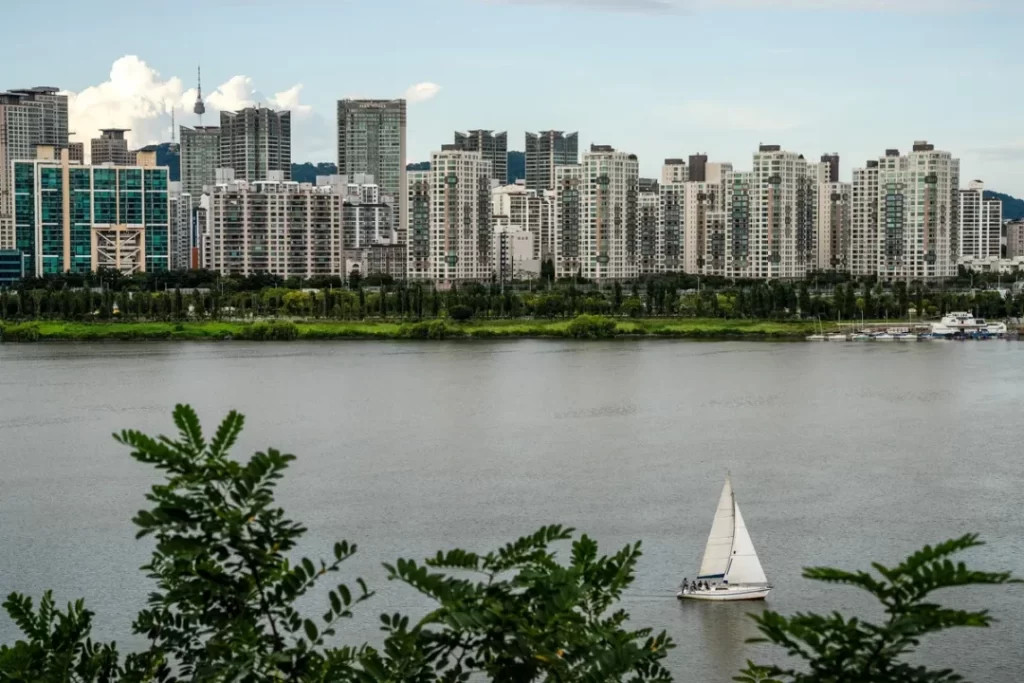
The Han River in Seoul
Buyer Beware
South Korean retail investors’ momentum in chasing rallies is clearly visible across various markets. Since Donald Trump won the U.S. presidential election last year and began his second term, trading volume on domestic cryptocurrency exchanges has surged, at one point reaching 80% of the turnover on the Kospi, South Korea’s benchmark stock index. Stablecoins pegged to fiat currencies have also attracted substantial retail capital.
Investors have also rushed into leveraged and inverse ETFs, products that amplify gains (and losses) by two to three times through derivatives. Due to strict domestic regulations on such products—including simulated trading requirements and high margin deposits—retail investors have turned to overseas markets, becoming major players in the global leveraged ETF market.
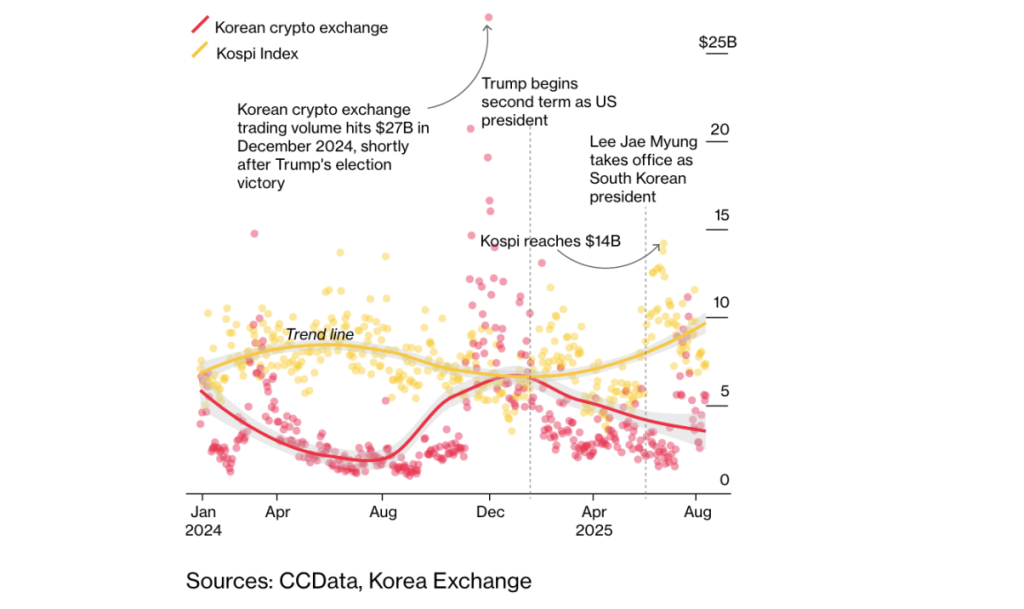
Comparison of Trading Volume on South Korean Cryptocurrency Exchanges and Kospi Index Trading Volume
South Korean retail investors’ high-risk behavior not only jeopardizes household savings but also strains the financial system, threatening overall economic stability. As investors flock to high-yield, high-risk assets, traditional financial instruments are falling out of favor, squeezing banks’ funding channels. In just six weeks after July this year, major South Korean banks lost nearly 40 trillion won (approximately $28.1 billion) in deposits.
“In Korea, investing is often treated as gambling rather than long-term planning—almost as brutal as Squid Game,” said Choi Jae-won, an economics professor at Seoul National University. “Once the bubble bursts and individuals face negative wealth shocks, the problem worsens: personal credit crises emerge, consumption power declines, and ultimately the entire national economy is affected.”
Regulators share these concerns. “We worry that a market crash could shock retail investors’ assets and the broader economy,” said Lee Yun-soo, a standing commissioner at the Korea Securities and Futures Commission.
Psychiatrists note that high-risk investments are increasingly taking a mental toll on individuals. “Without inherited wealth, owning a Gangnam apartment (property in Seoul’s affluent district) is a pipe dream,” said Park Jong-seok. Having lost approximately $250,000 in investments himself, he now runs a clinic specializing in treating investment addiction. “In this anxiety-ridden society, people are drawn to high-risk investments despite knowing the dangers. It’s as if the entire system pushes them forward, trapping them in a cycle of anxiety-driven investment addiction.”

Park Jong-seok
“Overnight Losses”
For some, the scars of investment crashes remain unhealed. Han Jeong-hoon, 35, once experienced the euphoria of his cryptocurrency wallet balance surging 30-fold to 6.6 billion won. But the 2022 Luna crash wiped it all away.
TerraUSD, a stablecoin project launched by South Korean Do Kwon, ultimately ended in failure. In August this year, Do Kwon pleaded guilty to fraud charges, and the project’s collapse wiped out approximately $40 billion in market value within days.
“My 6.6 billion won profit vanished overnight, and I ended up recovering less than 6 million won,” Han Jung-hoon said.
The crash completely transformed his life. While not abandoning cryptocurrency entirely, he has distanced himself from high-risk investments, focusing instead on meditation and even launching a YouTube channel to share his favorite breathing techniques. He now resides on the remote island of Jeju and occasionally travels to Bali for meditation retreats.

Han Zhengxun
Even so, social media platforms like YouTube remain flooded with tales of bold investment successes. Couples staking their entire savings on Bitcoin, a 27-year-old college student raking in tens of thousands monthly through high-frequency trading… These stories serve as bait for investors like Tony Kim.
Tony Kim currently holds full positions in stocks like Nvidia and Tesla. “I’ve made money using leverage before. That feeling of easy profits got me hooked,” he recalls. He once “turned $900 into $13,000 overnight,” only to lose all those gains in just three days. “You keep chasing that rush of sudden wealth.”